Data room › Section 1 of 8
The problem and the product
Sight loss takes away the ability to cross a road alone, read a medicine label or recognise a friend. Mavis is a pair of glasses that gives those things back — no phone, no app, no screen.
The problem
Sight loss takes away far more than sight
The tools that exist are either priced out of reach or built for someone else.
Navigational loss
Walking safely and independently becomes difficult, raising the risk of falls and narrowing where someone can work or socialise.
Informational loss
Labels, signs, letters and medicine packaging become unreadable, creating a daily dependency on other people. RNIB reports 90% of people with sight loss find packaging impossible to read.
Social isolation
76% report feeling lonely some or all of the time — roughly three times the general population, according to Fight for Sight, 2024.
What Mavis does
A pair of glasses that describes the world out loud
The wearer speaks to Mavis, or presses one of two buttons on the right temple, and Mavis answers.
Move safely
- Obstacle detection that measures distance and alerts through sound and vibration, quickening as an object gets closer. Range adjustable between one and three metres.
- Works offline — no signal required, so it does not stop working where coverage does.
- Turn-by-turn navigation to an address, a place name or a type of place.
- Live bus and train times on request, filtered by station or route.
Read the world
- Text reading for documents, signs, labels, menus and letters — including most handwriting.
- Barcode scanner that reads ingredients, allergens and nutrition aloud, and flags vegan, vegetarian and gluten-free.
- Scene description of people, objects and surroundings, brief or detailed, with wording the wearer can customise.
Know who is there
- Face recognition announces registered people by name as they come into view.
- Continuous mode for busy rooms, or names folded into a detailed scene description.
Stay connected
- Audio and video calls between devices, from the management portal, or to shared external contacts.
- Email read, written and replied to by voice, across Gmail, Outlook and most providers.
- Emergency audio and video calling — releasing January 2027.
Mavis is an assistive device. It is designed to support established orientation and mobility skills, not to replace them.
The hardware
Two frames and a case that keeps them connected
Designed, assembled and tested in Northampton. The case carries the SIM and GPS, so the glasses need no phone to work.
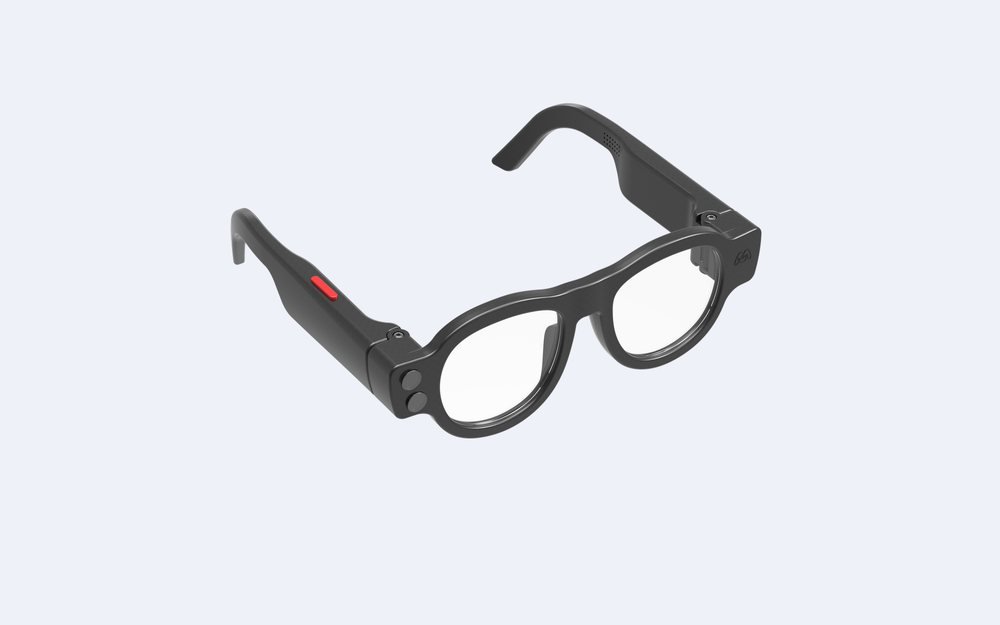
Mavis Viaro
The flagship frame. Compact, lightweight, every feature included.
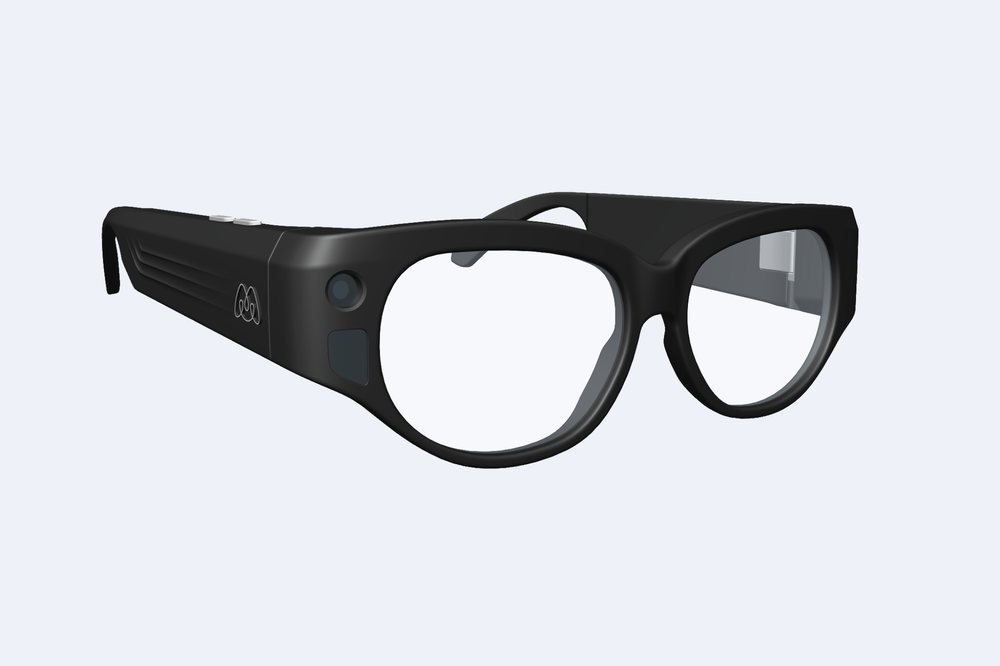
Mavis Itero
Larger, more formal, roughly twice the battery capacity, with a 2.5 mm jack for headphones or a hearing device.
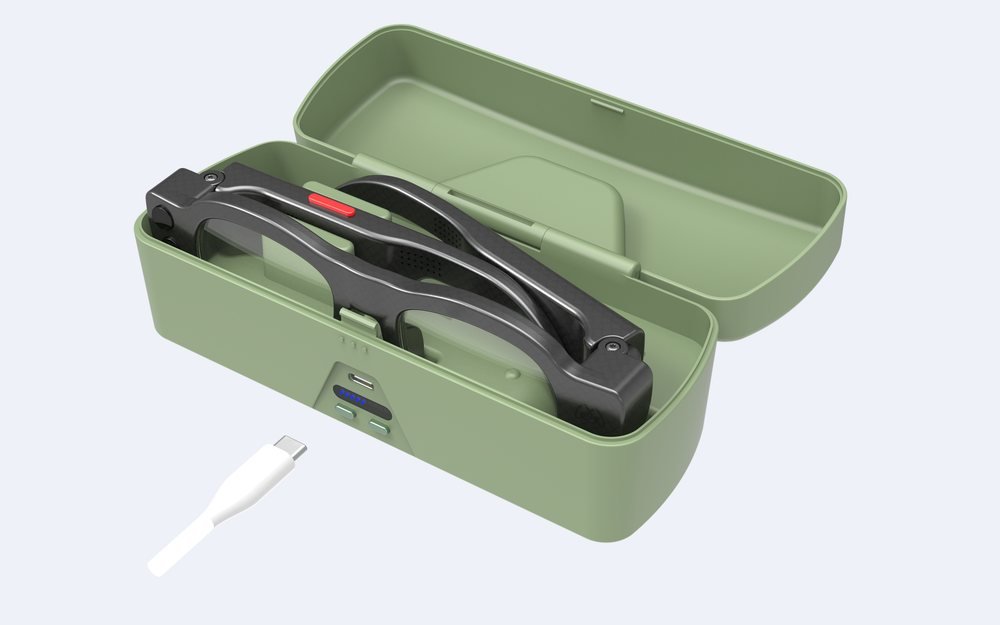
Smart Case
Charges by magnetic contacts and carries the 4G SIM and GPS that keep the glasses always on.
A third frame is in development for people with residual sight: everything Viaro does, plus a magnifying display, contrast adjustment and AI-corrected video. Planned for summer 2027.
| Sensing | Forward-facing camera, distance sensors for obstacle detection, microphones |
| Output | Built-in speakers and a vibration alert for noisy environments; 2.5 mm jack on Itero |
| Controls | Two buttons on the right temple, plus natural-language voice control |
| Connectivity | Wi-Fi with up to 30 saved networks; 4G LTE and GNSS positioning in the case |
| Charging | Magnetic contacts into the case; USB-C on the case |
| Weather | IPX rated for rain and splashes; not for submersion |
| Support | Security updates guaranteed for a minimum of five years from purchase |
| Management | Browser-based portal for devices, contacts, faces, Wi-Fi and settings |
Full technical detail is published openly at manual.mavistech.uk.